The Machine and the Butterfly
Act 1: The Million-Crown Mistake (1889)
In our previous chapter, we left the story of King Oscar II's challenge—and his massive cash prize to solve the Three-Body Problem—suspended in the middle. Much like a chaotic trajectory looping back upon itself, we return to it now. We proved mathematically that two bodies are trapped in a predictable, 2D elliptical cage: a trajectory cannot shoot off to infinity because the system has bounded energy. Furthermore, it cannot cross its own path in 2D space because that would shatter the uniqueness of determinism; if a line intersected itself, one exact set of state variables would suddenly have two different possible futures. This dictates a beautiful, absolute geometric law: 2D state-space systems can never be chaotic—they are strictly stable. But what about more than two variables? Our solar system certainly has more than two bodies. Is it fundamentally stable? Is it always predictable? The King wanted mathematical proof that adding a third body to the equations wouldn't break the clockwork of the universe.
domains that existed in his time. Henri "proved" the orbits were stable, won the gold medal, and proudly claimed the massive prize of 2,500 Swedish crowns ([1]).
Henri Poincaré, in 1887, took up that challenge. Recognized as one of the greatest mathematicians of his age, he submitted a massive, 200-page paper to the King's committee claiming he had solved it. He is today known as "The Last Universalist" because he excelled in all the mathematical domains that existed in his time. Poincaré "proved" the orbits were stable, won the gold medal, and proudly claimed the massive prize of 2,500 Swedish crowns [1].
But as the paper was being prepared for the prestigious journal Acta Mathematica, a meticulous 29-year-old assistant editor named Lars Edvard Phragmén found a tiny, nagging inconsistency in Poincaré's equations. He wrote to Poincaré asking for clarification.
Poincaré sat down at his desk to check his integrals. As he pulled at the mathematical thread, the entire tapestry of his proof unraveled. He realized, to his absolute horror, that he had made a catastrophic error. He hadn't proven the solar system was stable at all.
He immediately ordered the printing presses to stop and paid out of his own pocket to recall and destroy every printed copy of the journal. The recall cost him 3,500 crowns—a thousand crowns more than the King's prize itself [2].
But Poincaré was a true scientist. He didn't hide the mistake; he investigated it.
He realized that the gravitational pull of the third body destroyed the conservation of angular momentum. It broke the invisible pole holding the planets flat. The Z-axis was unlocked. And without the flat bounds of a 2D state-space, the Jordan Curve Theorem ceased to be a cage. A planetary trajectory could step over or under its past paths without ever intersecting them.
The orbits tangled into infinitely complex, non-repeating webs.
"It may happen that small differences in the initial conditions produce very great ones in the final phenomena," Poincaré wrote in his heavily revised, corrected paper. "Prediction becomes impossible." [3]
Without meaning to, in the process of losing a small fortune, Henri Poincaré had discovered chaos theory.
Act 2: The 60-Year Drought
Poincaré had proven that 3D chaos existed by proving a terrifying negative: the three-body problem of the solar system is fundamentally unpredictable. There is no single, master equation for the solar system that can be cleanly integrated with time to hand you a final, guaranteed position. And if an equation cannot be integrated, you cannot simply plug in to see where the planets end up. You must step through it numerically: calculate the exact forces at , draw a tiny line, recalculate the forces at , draw another tiny line, and so on.
To map a 3D chaotic web, you must do this thousands of times. If we start with an incredibly accurate—but ever so slightly imprecise—measurement of the Earth's position today, our step-by-step predictions might track perfectly for a while. But eventually, that microscopic error multiplies. It blows up in our face, derailing the math and feeding us a completely false future.
But for sixty years, no one could actually see this happen. Visualizing these chaotic webs required making hundreds of thousands of sequential predictions in time and painstakingly stitching them together. It is an agonizing, repetitive labor that human brains are not suited for, and a human lifespan cannot accommodate. The math of chaos went dormant. The 3D escape hatch was known, but the door was too heavy for a human to open.
To finally shatter the clockwork, we didn't need a better mathematician. We needed a machine.
Act 3: The Meteorologist and the Vacuum Tubes (1961)
Enter Building 24 at the Massachusetts Institute of Technology.
It is the winter of 1961. Edward Lorenz, a quiet meteorologist and mathematician, is not looking at planets. He is looking at the atmosphere. He stripped away the infinite complexity of the Earth's climate and boiled it down to a simple physical model: a slice of atmosphere being heated from below (by the Earth) and cooled from above (by space).
Lorenz distilled the physics of this boiling air into exactly three coupled differential equations:
Look closely at what Lorenz has done. This is a 3D State-Space.
- represents the rate of convective overturning (how fast the air rolls).
- represents the horizontal temperature variation.
- represents the vertical temperature variation.
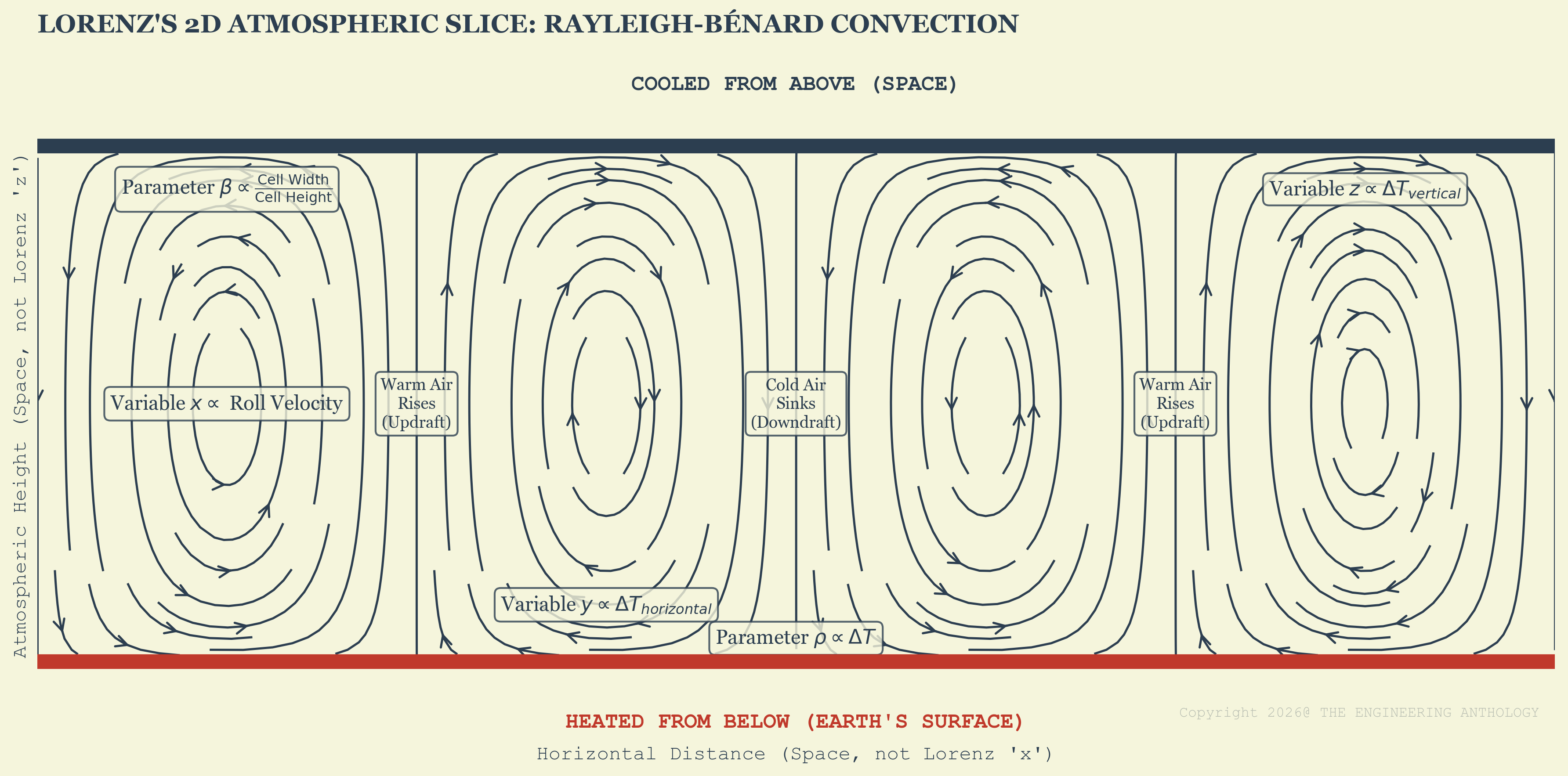
Rayleigh-Bénard convection: Hot air rises, cold air sinks, forming convection rolls. This is the physical basis for Lorenz's equations and the butterfly effect.
Notice that in the equations for the and axes, variables are multiplying each other ( and ). This mathematical non-linearity acts exactly like the third gravitational body in Newton's equations. It prevents the system from being integrated.
To solve it, Lorenz used a Royal McBee LGP-30. It was a massive, desk-sized computer that ran on 113 vacuum tubes and made a deafening whining noise as its magnetic memory drum spun at 4,000 RPM. It could perform sixty multiplications per second—laughable today, but in 1961, it was a miracle [4].
Lorenz programmed the three equations into the machine, gave it a set of initial starting numbers, and let it run. The machine chugged along, printing out a row of numbers every simulated "day" to map the changing weather.
Act 4: The Coffee Break that Broke the Universe
One afternoon, Lorenz wanted to examine a specific weather sequence in more detail.
To save time, instead of starting the computer from the very beginning of the run, he picked up an old printout, chose a row of numbers from the middle, typed them back into the machine as the new starting conditions, and went down the hall to get a cup of coffee.
When he returned an hour later, he looked at the new printout.
The new weather had started off perfectly matching the old weather. But after a few simulated days, the numbers began to drift. A few days later, they diverged completely. By the end of the run, the new weather pattern had absolutely zero resemblance to the original run.
Lorenz thought a vacuum tube had blown. He checked the machine. It was functioning flawlessly.
Then, he looked at the paper printout he had used to type in the starting numbers. The computer's internal memory calculated variables to six decimal places (for example, 0.506127). But to save space on the paper, the printer only printed three decimal places (0.506).
Lorenz had assumed that a difference of one part in ten thousand was effectively zero. In the 2D clockwork universe, a tiny change in the starting point results in a tiny, proportional change in the outcome.
But the weather is not 2D. And it is not linear.
Act 5: Sensitive Dependence
Lorenz had stumbled upon the exact nightmare Poincaré had predicted: Sensitive Dependence on Initial Conditions.
When the Z-axis is unlocked, trajectories stretch and fold mathematically. That microscopic missing slice of a decimal point—the 0.000127—was magnified by the non-linear equations with every single tick of the clock. Within a few dozen steps, it violently derailed the entire universe of the simulation.
This is the great paradox of engineering. The Lorenz equations are 100% deterministic. If you start the computer with the exact same infinite-decimal numbers, it will draw the exact same weather every single time. There is no randomness. No dice are rolled.
But because human beings (and our instruments) can never measure the physical universe to infinite decimal places, perfect determinism does not guarantee predictability. A butterfly flapping its wings in Brazil changes the atmospheric pressure by a microscopic fraction, eventually causing a tornado in Texas.
To truly understand the geometry of this chaos, we have to let the computer draw it.
Below, I have programmed Lorenz's exact equations. Start the simulation, and watch what happens when a deterministic trajectory is bounded in a finite room, but is allowed to use the Z-axis to jump over its own past without ever crossing it.
[The Strange Attractor: 3D Phase Space]
The 2D cage is broken. The butterfly has emerged.
Let us solidify the concepts in our quizzes.
[Diagnostic Check: The Strange Attractor]
References
- Barrow-Green, J. (1997). Poincaré and the Three Body Problem - A complete historical account of the King Oscar II prize, Poincaré's monumental error, and the birth of dynamical systems.
- Diacu, F., & Holmes, P. (1996). Celestial Encounters: The Origins of Chaos and Stability - Details the financial and professional fallout of Poincaré stopping the presses of Acta Mathematica.
- Poincaré, H. (1890). Sur le problème des trois corps et les équations de la dynamique - The revised paper where Poincaré formally outlines homoclinic tangles, the geometrical foundation of chaos.
- Lorenz, E. N. (1963). Deterministic Nonperiodic Flow. Journal of the Atmospheric Sciences, 20(2), 130-141. - The seminal paper where Edward Lorenz introduces his 3D convective model, the LGP-30 computer rounding error, and the concept of sensitive dependence on initial conditions.