The Shattered Clockwork
Act 1: The King's Prize and the 2D Cage (1887–1901)
We never do this. We try to keep the chronology of events in the story perfectly linear in our chronicles, but if ever we had to break it, this is the perfect place. And I promise I won't repeat anything; we will cross the years without intersecting previous discussion (you will understand the deep geometric meaning behind that statement shortly).
It is 1887. King Oscar II of Sweden was preparing for his 60th birthday in 1889 ([1]). To celebrate, he announced a global mathematics competition with a massive cash prize. The challenge? Solve the Three-Body Problem ([1]).
Act 2: A Monster-Act Really- Three-Body Problem
He (The King of Sweden) wanted a mathematician to prove that the solar system was fundamentally stable by deriving the exact mathematical equations for the gravitational dance of three celestial bodies ([1]). Newton had perfectly solved the Two-Body Problem ([2]). If you put exactly two massive objects in a void (like the Earth and the Sun) and apply the laws of gravity, the math is beautiful and deterministic. They pull on each other and lock into a perfect, repeating elliptical orbit. It is a closed loop. A pristine, predictable, 2D clockwork. But the moment you add a third body—say, the Moon, or Jupiter—the clean calculus shatters ([1]).
But before we watch that predictability shatter, we need to look at the stage where this dance is happening. Remember in the previous chapter when I promised to explain the term State-Space? in Act -1 We need to define it now, because it is the absolute key to understanding the geometric cage that keeps chaos at bay ([3]).
Act 3: Special-Appearance - State-Space
In our previous chapter on the Lotka-Volterra equations, if you handed another engineer the exact number of prey () and the exact number of predators () at any given second, they would have enough information to perfectly describe the system. They could plug those two numbers into the differential equations and map the exact populations a thousand years into the future.
Understand State-Space as this: it is the absolute minimum number of variables (called state variables) you must provide as information for someone to be able to completely calculate both the current and future state of a system ([3]).
Because the predator-prey system only requires two pieces of information ( and ), we say it exists in a 2D State-Space. You can map the entire universe of that ecosystem onto a flat, 2D sheet of graph paper. Every single point on that paper represents a unique "state" of the forest.
This is the ultimate secret of predictability. When a system is trapped in a 2D State-Space, the math is forced to draw its trajectory on a flat sheet of paper. And as we will soon prove, you cannot draw a chaotic, infinitely tangled web on a flat sheet of paper without breaking the laws of physics ([4], [5]).
Act 4: Finale - The Topological Straitjacket: I dare you! Try to Draw Chaos
In a 2D State-Space, chaos is not just unlikely; it is forbidden by the laws of topology ([4]).
To prove this, we are going to play a game. Your goal is to draw a "chaotic" trajectory—an infinitely tangled, non-repeating line that never settles down.
But because you are drawing a deterministic physical system, you must obey two strict mathematical laws:
- The Picard–Lindelöf Theorem (Determinism): Your current state dictates your exact future. Therefore, you cannot cross a line you have already drawn ([6]). If your line crossed itself, it would mean that from that specific intersection point, the system has two possible futures. The universe wouldn't know which path to take, and determinism would break.
- The Jordan Curve Theorem (Boundedness): The system does not have infinite energy, so populations cannot reach infinity. Therefore, you cannot draw outside the box ([5]). Furthermore, any closed loop you draw divides the plane into an "inside" and an "outside," trapping you on whatever side you are on.
Your Mission: Click and drag inside the box below. Try to draw a continuous, non-repeating path for as long as possible without hitting your own trail or the walls.
Rule 2: Do not hit the boundaries.
You probably didn't last very long.
Because you cannot cross your own path, and you cannot leave the bounded room, every curve you draw acts as a permanent wall. As you spiral around, you continuously shrink your own available universe. You will eventually run out of space and be mathematically forced to spiral tighter and tighter until you hit a dead end (Equilibrium) or fall into tracing the exact same loop over and over (A Limit Cycle).
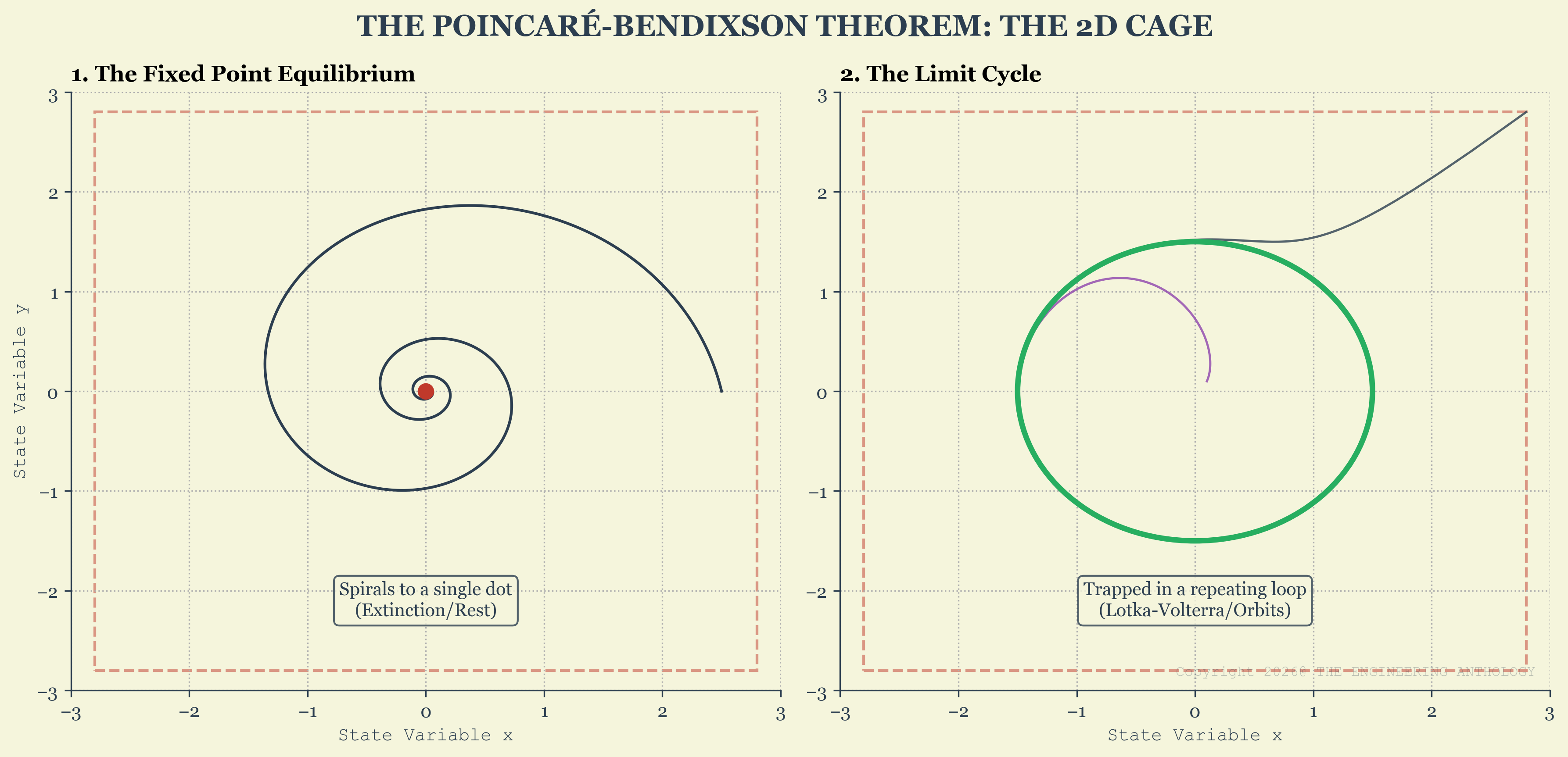
This inescapable geometric trap is the Poincaré-Bendixson Theorem ([4], [7]). In a 2D world, chaos is illegal.
[Diagnostic Check: Topological Constraints]
References
- King Oscar II of Sweden & The Göta Lejon Prize (1887–1889) - King Oscar II announced a prize competition to celebrate his 60th birthday. The winning entry was Henri Poincaré's work on the Three-Body Problem, which became foundational to chaos theory and dynamical systems.
- Newton, I. (1687). Philosophiæ Naturalis Principia Mathematica - Newton's laws of motion and universal gravitation, which elegantly solved the Two-Body Problem but revealed the mathematical intractability of three or more interacting bodies.
- Strogatz, S. H. (2015). Nonlinear Dynamics and Chaos: With Applications to Physics, Biology, Chemistry, and Engineering (2nd ed.) - Comprehensive treatment of state-space formalism, dynamical systems, and the fundamental concepts of chaos theory and bifurcation.
- Bendixson, I. (1901). Sur les courbes définies par des équations différentielles - The foundational work establishing the Poincaré-Bendixson Theorem: in 2D dynamical systems, any bounded trajectory either reaches a fixed point or a limit cycle. Chaos is mathematically impossible in two dimensions.
- Jordan, C. (1887). Cours d'analyse de l'École polytechnique - Original statement of the Jordan Curve Theorem: a simple closed curve divides the plane into an "inside" and "outside." Fundamental to topology and constraint arguments in dynamical systems.
- Picard, E. & Lindelöf, E. (1891–1894). Existence and uniqueness theorems - Mathematical guarantee that deterministic differential equations have unique solutions. If two trajectories could occupy the same point in phase space, the system would violate causality and determinism.
- Poincaré, H. (1890). Sur le problème des trois corps et les équations de la dynamique - Poincaré's revolutionary attack on the Three-Body Problem, introducing sensitive dependence on initial conditions and laying the mathematical groundwork for modern chaos theory. His work demonstrated that gravitational systems can exhibit unpredictable behavior despite being deterministic.